
New Labour Codes in India 2026: Status, 50% Wage Rule, PF Ceiling and Gig Worker Rules

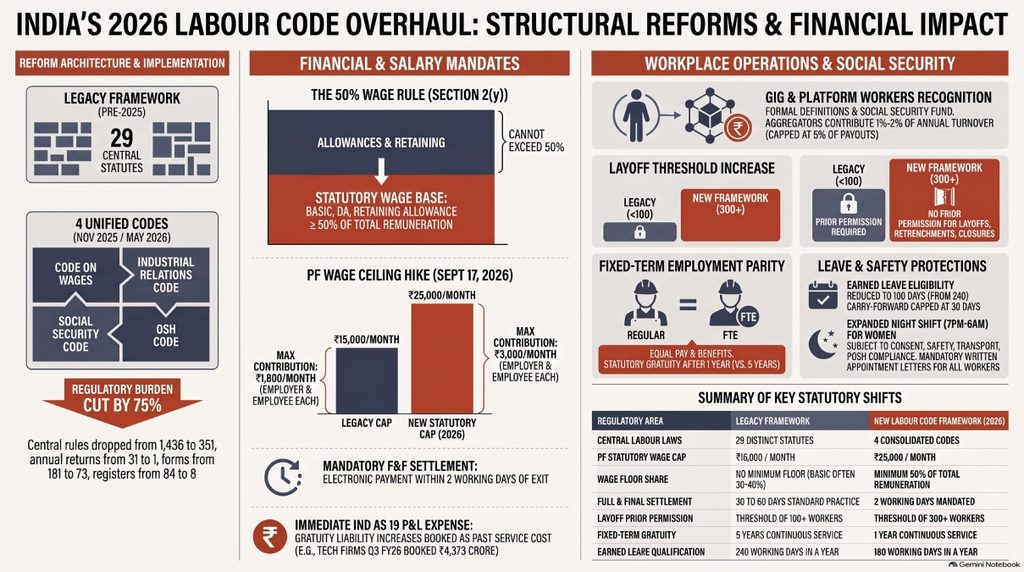
India’s four new labour codes have been in force since 21 November 2025. They replace 29 central laws, and final central rules arrived on 8 May 2026. Private employers still follow state rules, and only ten states had published final rules by 24 September 2026.
The 50% wage rule sets wages at no less than half of total pay, and the PF wage ceiling has stood at ₹25,000 since 17 September 2026.
Updated 19 October 2026. Since the February version, final central rules under all four codes have reached the Gazette (8 May 2026) and the PF wage ceiling has moved from ₹15,000 to ₹25,000 (17 September 2026). Listed companies have also reported what the new wage definition cost them. This edit adds those facts and rewrites the gig worker section around what has and has not been notified.
The PF worked example, the ₹50-70 million deal-cost estimate, the leave encashment rule, the strike notice rule and the 51% union threshold have been corrected as well. Two cost figures attributed to EY and KPMG could not be traced to either firm’s published work, so they are gone. Where an older source link no longer backed the sentence it sat on, the link stays and the sentence now reports what that source does say.
New Labour Codes in India: Current Status in October 2026
What Are the Four New Labour Codes?
Twenty-nine central labour laws, many drafted in the decades after Independence, once governed Indian employment. They gave the same word different definitions and the same duty different thresholds. Inspectors read identical provisions in different ways.
For HR managers, founders, payroll consultants and in-house counsel, that patchwork is ending.
India folded those 29 central statutes into four labour codes after consulting states, trade unions, industry bodies and policy think tanks. The codes formally came into force on 21 November 2025. The Government of India itself calls the change the “biggest labour reforms in independent India”, and official government communications and summaries published on the India.gov portal in its spotlight on labour reforms set out the scale of the consolidation.
The four labour codes are:
- The Code on Wages, 2019, which rationalises laws relating to minimum wages, payment of wages, bonus, and equal remuneration
- The Industrial Relations Code, 2020, which consolidates laws governing trade unions, standing orders, and industrial disputes
- The Social Security Code, 2020, which brings together provident fund, ESI, gratuity, maternity benefits and introduces a statutory category for gig and platform workers
- The Occupational Safety, Health and Working Conditions Code, 2020, which standardises workplace safety, welfare, and working conditions across sectors
The authoritative English compilation of these labour codes, as notified by the Ministry of Labour & Employment, is available here. It is the baseline legal reference for employers and practitioners.
At a Glance: India’s Labour Codes in October 2026
India folded 29 central laws into four codes. They have been in force since 21 November 2025, and final central rules followed on 8 May 2026. The Labour Secretary said on 24 September that ten states had published final rules, with the rest at draft stage.
Wages (basic pay, dearness allowance and retaining allowance, plus any excluded allowances above half of total pay) must make up at least 50% of remuneration. A higher PF wage ceiling of ₹25,000 has applied since 17 September 2026.
A four-day week with 12-hour days is possible only by agreement and inside a 48-hour week. Overtime exposure on those rosters is unsettled.
Gig and platform workers have statutory definitions and a registration process. The aggregator contribution rate had not been notified by 18 October, so the Social Security Fund has no platform money yet and no benefit scheme is live.
Employers with fewer than 300 workers need no prior government permission for layoffs, retrenchment or closure, though a state can set a higher number.
Labour Code Rules by State: Central Rules Are Final, States Are Still Notifying
Labour is a concurrent subject under the Indian Constitution, so state governments must notify their own rules before the codes work fully on the ground. In late 2025, The Hindu reported that the Centre was aiming for 1 April 2026 as the date for full operation across states, with draft rules to be pre-published for industry feedback. That date slipped.
Draft central rules went out on 30 December 2025. The final rules under all four codes were notified on 8 May 2026, along with Model Standing Orders, according to KPMG and EY. Cyril Amarchand Mangaldas dates the OSH rules a day later.
These central rules bind only employers for whom the Centre is the appropriate government, such as railways, mines, banks and central public sector units. A private factory or office follows its own state’s rules (Bar & Bench).
On 24 September 2026, Labour Secretary Chandra Bhushan Kumar said ten states had published final rules, that the rest had released drafts, and that he hoped every state and Union Territory would finish by 31 October (Business Standard). Law firm trackers fill in some names. Khaitan & Co’s August bulletin lists Andhra Pradesh, Arunachal Pradesh, Bihar and Gujarat among the states with final rules under all four codes, and Maharashtra, Karnataka, Tamil Nadu, Delhi, Haryana and West Bengal at draft stage (Khaitan Employment Law Bulletin, August 2026).
Several online trackers claim final rules for Maharashtra and Karnataka months earlier. Those claims contradict both the Labour Secretary’s count and the Khaitan list, so check the state gazette before relying on them.
Where a state has not yet notified its own rules, the Ministry’s FAQs say the older rules continue to the extent they are consistent with the codes. One date is close. The Social Security Code lets the old EPF and ESI schemes run for a year from 21 November 2025, so that clock ends around 20 November 2026 (Cyril Amarchand Mangaldas).
The Centre notified new EPF, pension and deposit-linked insurance schemes on 29 June 2026 (Khaitan Employment Law Bulletin, July 2026), and on 28 September the Labour Minister launched a 90-day awareness drive across 316 districts (GKToday).
The gap between central notification and state readiness is the window in which businesses can prepare. Once a state notifies its rules, compliance duties there stop being theoretical and become enforceable.
Why the Government Merged 29 Laws Into Four Codes
The government pitches the reforms as a bigger project than simplification. Editorials published on MyGov describe the codes as an attempt to bring India’s labour market in line with “best international practices,” with employer flexibility weighed against worker security.
Official Press Information Bureau (PIB) releases return again and again to two goals:
- Ease of Doing Business, through simplification, digitisation, and reduced inspector raj
- Expansion of social security for informal, unorganised and gig workers
Several PIB releases state this dual objective, including announcements on rollout progress, simpler compliance and international organisations welcoming the reforms.
One of those releases, posted on 22 November 2025, named the International Labour Organization and the International Social Security Association as welcoming bodies. The ILO’s Director-General said social dialogue among government, employers and workers would need to stay central as the reforms roll out.
Early numbers back the simplification claim. Grant Thornton Bharat’s count, released at the 24 September seminar, puts central rules down from 1,436 to 351, returns from 31 to 1, forms from 181 to 73 and registers from 84 to 8 (Business Standard). Academic readings are more guarded.
An NCAER working paper from April 2026, reissued by IZA in July, calls the likely effects on jobs and productivity mixed but broadly positive. It warns that compliance costs weigh harder on small firms and that firms may add contract labour to stay under thresholds (NCAER).
If carried out well, the codes could lift productivity and cut litigation, and they feed into India’s goal of becoming a developed nation, Viksit Bharat, by 2047. If carried out badly, they add uncertainty: state rules that differ from one another, uneven enforcement, digital systems that fail under load, and employers who cannot tell whether they comply.
On paper the reform is neat. On the ground, every provision of the four codes leaves some gap between rule and practice. Businesses that treat the codes as distant legal texts will pay for it, because wages, leave, social security, industrial relations and workplace safety now run on them.
50% Wage Rule Under the Code on Wages: How Salary Structures Change
How the Code on Wages Defines “Wages” (Section 2(y))
The “50% Wage Rule” is shorthand for a floor in the Code on Wages, 2019: wages must come to at least half of total remuneration. The phrase does not appear in the statute, but CFOs, HR heads and payroll teams are already reworking pay structures around it.
The Cyril Amarchand Mangaldas Guide to the Labour Codes explains that the Code on Wages, 2019 introduces one binding definition of “wages” across several statutes, something Indian labour law had never fully achieved.
Section 2(y) puts basic pay, dearness allowance and retaining allowance inside “wages.” A long list of other components starts outside the definition: house rent allowance, conveyance allowance, overtime, commission, the employer’s PF contribution, the value of housing or medical benefits, and similar heads. If those exclusions add up to more than half of total remuneration, the excess is added back to wages.
The outcome is a floor. Wages must come to at least 50% of total remuneration, which in CTC terms means basic pay plus DA has to sit near half of the package (Taxmann).
The Labour Ministry’s own FAQ works a case. Total remuneration is ₹76,000, of which ₹20,000 is basic plus DA, ₹40,000 is allowances and ₹16,000 is gratuity and retrenchment payments. Half of total remuneration is ₹38,000, so ₹2,000 of the allowances comes back into wages and statutory wages total ₹22,000.
Gratuity and retrenchment pay sit outside the test but inside the total.
The final Code on Wages (Central) Rules, 2026 do not restate any of this. The test rests on the Act and the Ministry’s FAQs (PRS). The Act lets the Centre notify a percentage other than 50, and no such notification had surfaced by mid-October.
Nor has the Ministry said that CTC must be restructured. A Khaitan & Co partner told Moneycontrol that the codes themselves do not mandate salary restructuring, and that it follows only where excluded allowances pass half of total pay (Moneycontrol, via Trilegal).
This changes how pay is designed. Relabelling components will not get around it.
For years, many Indian employers kept basic pay low on purpose, often at 30% to 40% of CTC, to maximise take-home salary while managing statutory contributions. The practice was legal under earlier laws, and in sectors competing hard for talent it was widely treated as best practice.
The new wage definition dismantles that model.
50% Wage Rule Impact on PF, Gratuity and Take-Home Salary
Statutory contributions, meaning Provident Fund (PF), gratuity and certain bonus calculations, are linked directly to “wages” as now defined. When the wage base rises, the statutory outgo rises with it, whether or not total CTC changes.
The Times of India, in an explainer on what the new labour codes mean for employees and employers, sets out the immediate trade-off.
For many employees, restructuring can mean a slightly lower monthly take-home, because more of the package flows into PF. The offset comes later: larger retirement savings and a bigger gratuity payout.
Take an employee earning ₹100,000 per month. Under a typical pre-code structure, basic pay might have been ₹35,000, with the balance spread across allowances. Under the new definition, basic pay must rise to at least ₹50,000.
Where the employer pays PF on actual basic, the 12% employer share moves from ₹4,200 to ₹6,000. That is an extra ₹1,800 a month in the employee’s retirement corpus. Many employers pay PF on the statutory ceiling instead. For them the PF line does not move at all, because both ₹35,000 and ₹50,000 sit above it.
Until 16 September 2026 that ceiling was ₹15,000, which capped each side’s contribution at ₹1,800 a month. On 17 September the Labour Ministry notified a ceiling of ₹25,000 (S.O. 5109(E)). The capped contribution is now ₹3,000 a month for employer and employee each, whatever the basic pay (BDO India; SCC Online).
The Ministry had said on 10 December 2025 that take-home pay would not fall if PF stays on the statutory ceiling (Outlook Money). That held at ₹15,000. At ₹25,000 the employee deduction rises by ₹1,200 a month for anyone whose PF was capped, and BDO adds that employees with Code-defined wages between ₹15,000 and ₹25,000 may now fall into mandatory PF coverage.
The September wage month is awkward. The new ceiling began mid-month, and Cyril Amarchand Mangaldas notes that two ceilings apply inside that wage period (Cyril Amarchand Mangaldas).
On its own, ₹1,800 a month does not sound large. Compounded over a 25-30-year career, though, it adds up.
Gratuity is where a capped-PF employee feels the restructuring most. Gratuity is last drawn wages × 15/26 × years of service, so a higher wage base raises the payout for long-tenured employees. On the example above, the accrual moves from about ₹20,192 to ₹28,846 per year of service, an extra ₹8,654 (roughly ₹721 a month). The ₹20 lakh ceiling continues to apply (Cyril Amarchand Mangaldas Guide).
Where attrition is low, this moves a large sum to long-serving staff over time.
Employers have already moved. Moneycontrol reported that IT firms redrew salary structures. They moved variable pay to quarterly cycles and in some cases dropped gratuity from the displayed CTC, so net pay fell for some staff even where CTC held or rose (Moneycontrol, via Trilegal). TCS said in July that it had reworked its salary structures for the codes from the June quarter (Business Today).
To run your own numbers, use our 50% wage rule calculator or read how PF is calculated under the new code.
Labour Code Cost for Employers: What Listed Companies Reported
For employers the arithmetic runs the other way, and the first full set of results is in.
EY India’s technical alert after the nationwide notification told employers to assess the financial impact of enhanced employee benefits. It gave no percentage, and neither did EY’s February 2026 Future of Pay report. The measured numbers come from company filings.
The large charges landed in the quarter ended 31 December 2025. TCS booked ₹2,128 crore. Infosys followed with ₹1,289 crore, and HCLTech with ₹956 crore, about ₹4,373 crore across the three (People Matters; Business Today). Management guided to a recurring margin hit of roughly 10 to 20 basis points.
KPMG’s March 2026 review of 223 large listed companies found 193 reporting an impact. The average came to about 6% of that quarter’s pre-tax profit and about 17% of the March 2025 gratuity and leave provisions, with sector averages running from 11% of provisions in IT to 41% in services (KPMG). ICRA put the hit to listed-company earnings at under 10 basis points on an annualised basis (ICRA).
An unnamed industry estimate reported by Business Today set the rise in employers’ wage bills at 1.5% to 10% (Business Today).
The charge has not stayed one-time. Tata Communications booked ₹60.58 crore in FY26, reversed ₹18.52 crore of it in Q1 FY27, and booked nothing in Q2 (Tata Communications filing). Mastek took a fresh ₹23.7 crore one-off loss in Q1 FY27 (Free Press Journal).
The impact is uneven. Companies that already keep basic pay at a relatively high share feel limited disruption. A firm’s bill depends on its pay mix and leave balances as well as how long its staff have served, which is why KPMG’s sector averages spread so widely.
CMS IndusLaw’s analysis of labour code implications for transactions and deal strategy says wage restructuring has become a diligence issue in mergers and acquisitions.
Payroll models designed for the old laws can now hide large future liabilities. The Code gives employees three years to claim unpaid or underpaid wages, so past payroll errors can surface late. CMS says buyers may ask for specific indemnities or price adjustments, or hold money back in escrow to cover them.
Full and Final Settlement Rule: Two Working Days, Not 48 Hours
The full and final (F&F) settlement rule, popularly called the “48-hour rule,” gets less attention than the wage definition and may disrupt payroll just as much.
The statute says two working days, not 48 hours, so weekends and holidays stretch the calendar. Section 17(2) of the Code on Wages requires wages to be paid within two working days when an employee is removed, dismissed, retrenched or resigns, or when an establishment closes. Unlike the old Payment of Wages Act, it names resignation outright and drops the old ₹24,000 wage ceiling (LiveLaw).
The Model Standing Orders notified on 8 May carry the same two-day electronic payment duty (CMS IndusLaw). PwC’s page on the new codes lists the two-day final payment among the added cost items for employers.
Previously, 30 to 60 days was common. Sometimes longer.
It is unclear when the clock starts. The LiveLaw author reads it as the date the resignation takes effect, meaning the last working day, since counting from the date of the letter cannot work when a notice period is served. No Ministry or court clarification exists.
Nor is it settled how much of an exit settlement the deadline covers. Grant Thornton Bharat flagged on 24 September that it is unclear whether the two days apply only to statutory wages or to the full settlement (Business Standard). Gratuity and PF follow their own processes.
LiveLaw also lists as unresolved whether an employer can hold wages back pending exit clearance or recover unserved notice pay from them. The penalty side is real: an authority can order compensation of up to ten times the unpaid claim, on top of the claim itself.
Meeting the deadline takes live leave balances, automated gratuity calculations and HR, payroll, finance and compliance teams working from one set of data. Legacy HRIS platforms and spreadsheet-driven payroll struggle to deliver that. A late settlement now breaches the rule.
The 50% wage rule and the two-day settlement mandate point the same way, away from flexible pay structuring and delayed exits and toward predictability and worker financial security.
Employees gain slowly, through larger retirement savings and gratuity. Employers face an immediate technical adjustment that punishes poor systems.
Salary reform spills into leave policy, social security contributions, accounting treatment and deal valuations.
Leave, Working Hours and Appointment Letters Under the New Labour Codes
Earned Leave Eligibility Reduced from 240 Days to 180 Days
The wage definition lands in spreadsheets. The leave and working-condition rules land in daily working life, and for many workers, especially those on the margins, they change something real.
The codes change eligibility for earned annual leave. Under earlier laws such as the Factories Act, workers needed 240 days of continuous service in a calendar year to qualify. That threshold shut out a vast number of workers whose employment was intermittent, whether seasonal or contract-based.
The OSH Code reduces this requirement to 180 days worked in a calendar year, with one day of leave earned for every 20 days worked. The Ministry’s FAQs of 16 March 2026 confirm the treatment (SCC Online), and the full text sits in the Ministry’s official compilation. BDO India’s alert on the provisions notified from 21 November 2025 adds that the wider wage definition feeds into leave encashment calculations.
The adjustment looks modest on paper. It is not.
Contract workers in construction, logistics, hospitality, retail and manufacturing often rotate between projects or locations. Seasonal workers may put in long stretches for part of the year and then be released. Under the earlier 240-day rule, many narrowly missed eligibility, year after year.
By lowering the bar to 180 days, the codes extend paid leave to millions who were excluded before from what is arguably a basic workplace right.
This change also nudges India closer to international norms, where leave eligibility is rarely contingent on near-full-year attendance.
Leave Encashment Rules: 30-Day Carry-Forward Cap and Year-End Encashment
Annual leave can no longer pile up without limit. Section 32 of the OSH Code caps carry-forward at 30 days. Leave that an employer refused after the worker applied for it carries forward with no cap.
At the end of the calendar year a worker may demand encashment, including of any balance above 30 days, and all leave due is paid out when the worker leaves (SCC Online; KSK).
Several explainers say balances above 30 days must be encashed at year-end. The text gives the worker that right on demand. It does not impose an automatic duty on the employer, and JSA reads it the same way: the excess can be encashed on request, once a year (JSA).
The rule covers workers, not managerial or administrative staff, and the FAQ counts supervisors drawing up to ₹18,000 a month as workers (Lexplosion). A state law that is more favourable to the worker prevails to that extent. KPMG India’s blog from 4 December 2025 notes that employers may need to recalculate gratuity and leave encashment on the wider wage definition, and that ambiguity persists for variable and one-time payments.
It was not uncommon for long-tenured employees to pile up leave balances that sometimes ran into hundreds of days. These often surfaced only at exit, which gave employers a sudden financial shock and left employees waiting. The 30-day carry-forward cap and the year-end encashment option make the position more predictable for both sides.
Four-Day Week and 12-Hour Shifts: What the 48-Hour Limit Allows
On working hours, the codes largely preserve familiar boundaries. The standard remains an 8-hour workday and a 48-hour workweek.
The 12-hour day is where the position gets murky. The Ministry said in a post on X in December 2025 that a four-day week is “only an option, not an obligation.” Up to 12 hours a day on four days, with three paid days off, is possible if weekly hours stay within 48 and both employer and workers agree (People Matters).
Khaitan & Co’s reading of the Ministry’s FAQs is that the codes speak only of normal working hours in a day, and that any extra hour, while not prohibited, carries overtime implications (Khaitan & Co). Law firm summaries of the March 2026 FAQs read it more tightly: overtime at twice the normal rate starts after the eighth hour, even where a 12-hour day is prescribed (SCC Online). Corporate Professionals takes the opposite line on the final OSH Rules, and says a long day is not overtime if weekly hours stay within 48 (Corporate Professionals).
On the stricter reading, a roster of four 12-hour days would carry 16 hours of overtime every week.
Two other rules narrow the options. A 13 May 2026 notification caps continuous work at five hours before a rest interval of at least 30 minutes (SCC Online). And the Central Rules fix no spread-over figure, which leaves that to the states (EY).
As of mid-October, no state notification expressly allowing a four-day week or general 12-hour shifts had surfaced. Our explainer on whether a four-day week is legal in India covers the 48-hour limit in more detail.
Manufacturing, warehousing and logistics run around the clock, and compressed rosters suit their production cycles. Whether such rosters are legal depends on the state rules and on the overtime reading above.
Mandatory Appointment Letters Under Rule 6 of the OSH Central Rules
Every worker must now receive a written appointment letter. The provision gets little attention and reaches far.
This applies across sectors, employment types, and wage levels. Rule 6 of the OSH Central Rules sets a prescribed format. The letter records the type of employment (regular, fixed-term or contractual), skill category, wages, PF and ESI applicability, maternity benefit and the establishment’s labour identification number (iPleaders).
DLA Piper’s alert tells employers to onboard new hires on the prescribed forms and to update muster rolls, wage registers and overtime records. Sources differ on whether existing staff get a three-month transition, so check the rules of your state. Our private-sector guide to appointment letters covers the format.
The Times of India’s broader analysis of the change the new labour codes bring says the requirement has large consequences for India’s informal workforce.
For decades, a large share of India’s workforce has worked on verbal agreements, with no written terms, no clarity on wages, no documented leave entitlements and little proof of employment in a dispute. A mandatory appointment letter changes that. It creates a paper trail and defines expectations.
It gives workers something tangible to rely on in a courtroom, when applying for a loan, when enrolling in a social security scheme and when resolving a workplace disagreement.
Employers answer for more too, since ambiguity is harder to defend once terms are written down.
The leave and working-condition reforms standardise without adding rigidity. They tighten where worker welfare has been weakest, in leave access, documentation and predictable benefits, and they loosen where operations need flexibility.
These reforms depend on enforcement and awareness. Workers have to know their entitlements. Employers have to bring internal policies, HR manuals and payroll systems into line with the new thresholds.
Without that, even well-drafted provisions stay theoretical.
The gap between rule and practice is widest for gig and platform workers.
Gig Worker Social Security in India: What Is Notified in October 2026
Who Counts as a Gig Worker, Platform Worker or Aggregator
The gig and platform economy is where the new labour codes break most clearly from the past. For years this segment grew faster than the law that governed it. Food delivery partners, ride-hailing drivers, home-service professionals, freelance technicians and millions of others earning a living through digital platforms sat in a legal blind spot.
They were not employees in the traditional sense, and they were not fully independent either. Mostly, they sat outside the formal social security system.
The Social Security Code, 2020, attempts to correct this imbalance.
DD News, in its analysis of what the new labour codes mean for gig and platform workers, explains that the legislation formally acknowledges that the nature of work has changed.
For the first time in Indian labour law, the code introduces statutory definitions for:
- Gig workers: individuals who perform work outside a traditional employer-employee relationship
- Platform workers: those who access organisations or customers through online platforms
- Aggregators: digital intermediaries that connect service providers with users
By creating these categories, the law deliberately moves away from the binary classification that has dominated global labour litigation: employee versus independent contractor.
The Social Security (Central) Rules, 2026, notified on 8 May, turned the definitions into a registration process. A worker qualifies after 90 days with one aggregator, or 120 days across several, in the previous financial year, and loses eligibility at 60. Aggregators must register on the Shram Suvidha portal, upload their existing workers within 45 days (around 21 or 22 June 2026), and report new onboarding and exits in real time or daily (MediaNama).
MediaNama’s own reading is that the day thresholds may shut out many workers who log few days with any single platform.
Aggregator Contribution to the Social Security Fund: 1% to 2% of Turnover
Fisher Phillips, in its analysis of the Indian labour code reforms, notes that India has effectively sidestepped this debate by creating a third category of worker, with its own rights and protections, instead of forcing gig work into outdated legal boxes.
The main vehicle is the Social Security Fund for unorganised, gig and platform workers. Aggregators must contribute between 1% and 2% of their annual turnover to it, subject to a cap of 5% of the amount paid to gig and platform workers.
The contribution tracks platform scale instead of individual employment contracts, so large digital businesses pay in without every worker becoming a traditional employee.
The money has not started to flow. As of 18 October 2026, no notification had fixed the contribution rate under Section 114(4) or the start date under Section 114(5), according to a TaxGuru analysis dated 19 October. IMPRI said the same on 16 September (IMPRI).
The Social Security Fund has no platform inflow yet. Open tax questions include whether the levy is deductible and how state fees count toward turnover.
States have moved faster. Karnataka has collected a welfare fee since 13 February 2026: 1% of each payout, with per-trip caps that run from 50 paise on a two-wheeler ride to ₹1.50 on some logistics and professional services (SCC Online). Platforms challenged the law in the Karnataka High Court.
On 3 July 2026 the court refused to stay it but barred coercive action against platforms that deposit the disputed fee with the court, and the Centre’s counsel backed the petitioners on whether the state Act clashes with the central code (LiveLaw). No outcome from the 14 August hearing had been reported. Telangana, Bihar and Jharkhand have enacted gig worker laws, but their start dates could not be confirmed.
Rajasthan’s 2023 Act has no verified rollout, and Maharashtra has only a Bill.
A policy paper from the IZA Institute of Labor Economics takes a harder line. Published in December 2025 and written by Santosh Mehrotra and Kingshuk Sarkar, it argues that the codes miss chances for genuine reform and notes that provident fund and benefit provisions keep a 10-worker threshold, which leaves most unorganised workers outside.
Gig Worker Benefits, Portability and e-Shram Registration
On paper, the Social Security Code lets the Centre notify schemes for life and disability insurance, health and maternity benefits, old-age protection and skilling. In practice, no scheme has been notified under Section 114. Business Standard reported in March that the Centre was drafting an insurance scheme with life and accident cover, to follow the final rules (Business Standard).
Health cover under Ayushman Bharat PM-JAY, announced in the 2025-26 Budget, was described by PIB in August 2025 as yet to be launched (PIB). Reporting through May (MediaNama) and into September 2026 still describes it as undelivered to most workers. Our guide to Ayushman Bharat enrolment and eligibility for gig workers covers the route as it currently runs.
Portability matters most in the planned benefits. They are meant to follow the worker, not the platform. A delivery partner who works with several apps, or switches cities or kinds of gig work, keeps accumulated social security coverage.
This portability is meant to run through Aadhaar-linked Universal Account Numbers (UANs) and registration on the e-Shram portal, the central database for unorganised and gig workers. Littler Mendelson’s snapshot of the overhaul describes the same Aadhaar-linked design. The aim is continuity of benefits across platforms and over time, which employment-linked social security systems struggle to offer.
NITI Aayog put the gig workforce at about 7.7 million in 2020-21 and projected 23.5 million by 2029-30. Ministry statements have cited over one crore for 2024-25 (newsonair).
Registration lags far behind. About 3.37 lakh platform workers were on e-Shram in August 2025, over 5 lakh by December, and around 11.5 lakh by 18 August 2026 (PIB).
Insurance, healthcare and retirement-linked benefits have traditionally stayed with formal employment. The labour codes try, for the first time, to extend a version of that safety net to the digital economy. Registration of 11.5 lakh against a workforce above one crore shows how far delivery still has to go.
Platforms get a mixed deal. Once the rate is notified they face a cost they cannot avoid, because contributions to the Social Security Fund will not be optional and compliance will need reporting systems. In return, they get statutory definitions in place of years of litigation over worker classification.
Fisher Phillips’ guidance for multinational employers cautioned in December 2025 that many provisions depend on state rules still to be issued and that the rollout would be uneven. The Karnataka litigation shows what that looks like for platforms.
Much depends on execution. The contribution rate, the benefit scheme, the fate of state levies and the delivery systems will decide whether this structure delivers protection or stays aspirational. The Labour Secretary said on 24 September that a “Labour Stack” pilot, linking worker databases to welfare schemes, would start within 15 days (Business Standard).
The codes treat gig work as a permanent feature of India’s labour market, one that can no longer sit outside the social security system.
Industrial Relations Code 2020: Layoff Rules, Fixed-Term Employment and Strike Notice
Layoff and Retrenchment Permission: The New 300-Worker Threshold
Industrial relations is the most politically sensitive part of India’s labour law. Weighing worker protection against employer flexibility has been hard, and it often produced rigid rules that discouraged scale while failing to protect workers from informalisation.
The Industrial Relations Code, 2020, tries to reset that trade-off.
Among the most widely discussed changes is the higher threshold for prior government permission to lay off or retrench workers or to close an establishment. Until now, any industrial establishment with 100 or more workers needed government approval before taking such steps. The approval process could stretch for months or even years, which gave firms a strong reason not to grow past a certain size.
The Industrial Relations Code raises this threshold to 300 workers.
PwC India’s page on the new codes lists the 300-worker threshold among the changes for business, next to added costs such as the Re-skilling Fund. Trilegal’s summary notes the move from 100 to 300 and adds that employers with fewer than 50 workers are exempt from the one-month notice and retrenchment compensation requirements. Section 77 lets a state government notify a higher number than 300.
Notifications using that power under the 2020 Code could not be verified for Rajasthan, Uttar Pradesh, Maharashtra or Haryana, and a February 2026 state tracker found no state above 300. Treat any claim of a state-level increase with care until you see the gazette notification. Under the Central Rules, permission applications go in at least 15 days before a layoff, 60 before retrenchment and 90 before closure (PRS).
Firms with 100 to 300 workers now have more freedom to restructure operations in response to market conditions without waiting through long bureaucratic processes. Establishments above 300 workers still need government oversight, so workers in larger units keep that protection.
The NCAER paper tempers the optimism. It finds that fewer than 12% of Indian enterprises sit in the 50 to 99 worker band, and concludes that the gains from the higher threshold are limited (NCAER).
Fixed-Term Employment: Pay Parity and Gratuity After One Year
The Industrial Relations Code also formally recognises Fixed-Term Employment (FTE).
Indian employers that needed flexibility often relied on contract labour supplied through contractors, even for work that was not truly intermittent. That produced a two-tier workforce, with permanent employees on one side and contract workers with fewer protections on the other.
The new code allows employers to hire workers directly on fixed-term contracts, while mandating full parity with permanent employees on wages, working hours, allowances, and statutory benefits. Acuity Law’s IR Code FAQ describes the definition in Section 2(o): direct engagement under a written contract, pay and benefits equal to comparable permanent workers, proportionate statutory benefits, and no retrenchment when the term simply ends. A Genius HRTech survey of 1,459 companies found about 75% expecting wider use of fixed-term hiring (Outlook Money), though the sample is self-selected and comes from an HR vendor.
Fixed-term employees also get gratuity after just one year of continuous service, instead of the five years required for permanent employees. The rule accepts that such engagements are temporary, and it stops time-bound contracts from shutting workers out of long-term benefits.
KPMG’s Global Mobility Services flash alert and Littler Mendelson’s snapshot both confirm the one-year test. The Ministry’s 16 March 2026 FAQ adds a limit: the year must be served under the contract, so an 11-month contract does not qualify (SCC Online). Our guide to fixed-term gratuity and severance liabilities works through the cost, and on 28 September the Labour Minister released an employer’s guide to fixed-term employment (GKToday).
Re-Skilling Fund, Union Recognition and Strike Notice Rules
Retrenchment now carries a further obligation. Employers must pay 15 days’ last drawn wages for every retrenched worker into a Worker Re-skilling Fund within 10 days of retrenchment, and the Government then transfers the money to the worker’s bank account within 45 days. KPMG’s analysis of workforce mobility and restructuring under the new codes says the fund is meant to finance retraining and upskilling for displaced workers, so they do not have to manage the transition on their own.
The fund was notified alongside the final central rules in May (Khaitan Employment Law Bulletin, June 2026).
Union recognition has also been restructured.
Where several unions operate, the Code requires recognition of the union with at least 51% of workers on the muster roll as the sole negotiating union. If none reaches 51%, a negotiating council of unions with at least 20% backing is formed. The Central Rules add a separate route: a lone registered union with at least 30% membership must be recognised, for three years extendable to five, after a secret-ballot verification at the employer’s cost (PRS; KSK).
The stated aim is clearer accountability and steadier industrial relations. Vinod Rai’s paper for the Institute of South Asian Studies at the National University of Singapore, published in December 2025, argues that stricter strike procedures could weaken unions’ bargaining power.
The right to strike has not been eliminated, but it is more tightly regulated. The notice rule in Section 62 now covers every industrial establishment instead of public utilities alone (Acuity Law). Notice must come within the 60 days before the strike, and no strike may start within 14 days of giving it or before the date it names.
Strikes are also barred during conciliation and for 7 days after, during tribunal proceedings and for 60 days after, and during arbitration and for 60 days after (official compilation). Backers say the bar brings predictability and protects the public interest. Critics say it weakens workers’ bargaining power.
The pattern recurs across the codes: rights remain, but procedure now governs how they are used.
Opposition has been loud. Ten central trade unions held a joint protest in late November 2025 and a 24-hour general strike on 12 February 2026, and they want all four codes withdrawn (Business Standard). Court challenges have been narrow.
The Kerala High Court dismissed a petition against the continuation of existing labour tribunals on 8 April 2026 and found the provision not arbitrary (SCC Online). No report of a stay on any provision of the codes had surfaced by mid-October.
The industrial relations reforms aim to make workforce adjustment possible without making workers disposable. Whether that holds depends on how state governments frame their rules and how conciliation mechanisms work on the ground.
Employer flexibility under the new codes is formal and conditional, and tied to explicit social obligations. It no longer rests on workarounds.
OSH Code 2020: Workplace Safety, Women’s Night Shifts and Welfare Rules
Safety Standards and Free Annual Health Check-Ups
Of the four labour codes, the Occupational Safety, Health and Working Conditions Code, 2020 is in many ways the quietest, and it covers the widest range of workers. It pulls together provisions from several older laws and aims to set common norms for safety, welfare and working conditions across sectors that were once regulated unevenly or not at all.
The code moves toward universal minimum standards. Earlier, coverage depended on the type of establishment (factory, mine, plantation, shop or office) and on headcount thresholds. Workers doing similar tasks often had very different protections depending on where they worked.
That fragmentation has narrowed.
The Central Rules require free annual health check-ups for workers above 40 in dock work and in building and construction work, with mines covered by a separate rule (BDO India). Law firms disagree on whether factories are also covered, and the Ministry’s FAQ says the age threshold depends on whether the Centre or the state is the appropriate government (SCC Online).
Occupational illnesses often emerge later in life, and early detection can cut long-term health costs, absenteeism and disability. The provision also shifts employer responsibility from reacting to accidents toward managing health in advance.
Can Women Work Night Shifts? Consent and Safety Rules
For women workers, the code removes a long-standing restriction on night work.
Perhaps the most discussed reform is the permission for women to work night shifts, defined as work between 7:00 PM and 6:00 AM. Earlier labour laws were framed as protective but in effect barred women from large parts of industries such as manufacturing, logistics, BPOs and continuous-process operations, where night work cannot be avoided.
Under the new code, women may work night shifts with their consent, provided the employer puts adequate safety measures in place.
Fisher Phillips’ detailed guidance for multinational employers working through India’s labour law reforms sets out the practical compliance expectations for this change.
The Central Rules list the safeguards. Employers need the woman’s written consent, transport to and from her residence, lit routes and washrooms, emergency numbers displayed at the workplace and in vehicles, and compliance with the POSH Act. Most summaries add CCTV coverage on the route, though KPMG’s reading is that employers should consider it (iPleaders; Bar & Bench).
Consent must be genuine and not coerced, and employers remain accountable for a safe working environment.
The law no longer assumes that women need protection from certain types of work. It aims to protect them inside those workplaces and leaves the choice to them.
Crèche Rules, Welfare Provisions and the Expanded “Family” Definition
The Social Security Code also expands the definition of “family” for a woman employee to include her parents-in-law, subject to an income cap (PIB). The change looks modest, but it fits the way social roles and domestic labour work in India.
Welfare requirements have also been standardised. Establishments with 50 or more workers must provide a crèche, the benefit is gender-neutral under the Ministry’s FAQ, and where no crèche is provided an allowance of at least ₹500 a month per child, for up to two children, applies (PIB factsheet above; SCC Online). Summaries of the OSH rule differ on whether the line is “50 or more” or “more than 50”, so check the text.
Provisions on canteens, restrooms, and drinking water are standardised across establishment types as well. Inter-state migrant workers with at least 180 days in an establishment get a lump-sum fare to their home state once in twelve months (KPMG).
The safety and welfare provisions move from selective coverage to a baseline standard at work. They cover everyday conditions as well as catastrophic accidents: health monitoring, sanitation, childcare access and the participation of women.
As elsewhere in the codes, execution is the test. Safety audits, workplace upgrades, consent documentation and grievance mechanisms need steady attention, not one-time compliance.
The codes treat workplace safety and women’s participation as core labour market issues.
Labour Codes and M&A: Accounting Charge, Contract Labour and Deal Risk
Ind AS 19 and the Labour Codes: How the Gratuity Charge Is Booked
For companies involved in mergers, acquisitions, spin-offs, or large-scale restructuring, the new labour codes change how labour law risk is priced. What was once treated as a post-closing compliance exercise now sits inside the deal economics.
This shift is most visible where the 50% wage rule meets valuation, liability estimation, and financial reporting.
CMS IndusLaw, in its analysis of labour code reforms and their implications for transactions and deal strategy, makes the point plainly: compensation structures that look compliant under legacy laws may hide material future liabilities under the new wage definition.
Take a target with 1,000 workers and an average annual CTC of ₹800,000, with basic pay at 35% of CTC. Moving basic to 50% adds ₹120,000 a year of wage base per worker.
Gratuity on that extra base costs about ₹5,800 a year per worker, which is 15/26 of a month’s wages for each year of service, or ₹5.8 million across the workforce. Employer provident fund adds up to ₹14,400 per worker (₹14.4 million) but only where the employer contributes on actual wages above the statutory ceiling. At the top of that range the extra annual cost is about ₹20.2 million.
This is the editor’s arithmetic on stated assumptions, not a forecast.
Earlier versions of this post put the figure at ₹50 to 70 million. On the same assumptions that was too high. Leave encashment, overtime on a higher wage, bonus and one-off past service cost come on top, and each depends on the target’s tenure and pay mix.
The accounting rule is firmer than the deal arithmetic. Business Standard reported on 28 December 2025 that the Institute of Chartered Accountants of India treats the gratuity change as a plan amendment, so the increase is past service cost and goes to profit and loss immediately under Ind AS 19. Changes to leave obligations are expensed immediately too.
For a listed company with a March year-end, the charge belonged in the results for the quarter ended 31 December 2025, which falls inside FY 2025-26 (Business Standard; ABCAUS summary of the ICAI FAQs).
Three limits apply to that summary. Spreading the cost over the vesting period is allowed under AS 15, which governs companies outside Ind AS, and not under Ind AS 19.
A genuine pay rise, as distinct from a restructuring of the pay mix, is treated as an actuarial change and not a plan amendment. And the ICAI did not require the charge to be shown as an “exceptional item”: 104 of the 193 large listed companies in KPMG’s sample that reported an impact did so, while 59 put it inside employee benefits expense (KPMG).
We read the ICAI position through these two secondary summaries, since the FAQ document itself could not be retrieved.
Variable pay is still unsettled. PwC India’s Anshul Jain told Business Standard that the calculation period and the treatment of stock options and variable pay in wages remained open. The final Central Rules then dropped a draft clarification that would have kept items such as annual bonus, stock options and meal vouchers out of the gratuity wage base (EY).
The Ministry’s non-binding FAQ says annual performance incentives are not wages (SCC Online). A buyer should price that gap.
An earlier version of this post cited KPMG for a 20% to 40% rise in gratuity liabilities. The KPMG alert linked there is a workforce-mobility note, and the figure could not be traced to it. KPMG’s measured data, summarised earlier, is the better guide.
CFOs and financial controllers can no longer treat labour compliance as an HR-only matter. Actuaries have to revalue gratuity and leave obligations again as the rules and FAQs settle each open point, and finance teams must explain every revision to boards, auditors and investors.
Contract Labour and the Core Activity Test Under the OSH Code
The labour codes also sharpen scrutiny of contract labour, another area of heightened risk in deals.
Establishments may not engage contract labour for “core activities”, meaning work that is perennial in nature, central to the business, and ordinarily performed by regular employees. Section 57(1) of the OSH Code carries three exceptions: the activity is ordinarily done through a contractor, full-time workers are not needed for most of the working hours, or there is a sudden increase in work within a set period (Courtbook, unofficial text of OSH s.57). The principle: contract labour must not systematically replace regular employment.
Trilegal’s contract labour repository shows how this requirement forces businesses to review workforce composition, especially in sectors that have long relied on contractors.
In practice, the distinction between core and non-core activities is not always obvious. Assembly-line workers in a manufacturing plant are almost certainly engaged in core activity. IT helpdesk staff in a software services company may not be.
But there are many grey areas in between, and misclassification carries consequences. A Ministry order of 7 July 2026 now sets the procedure for deciding whether an activity is core, with a decision due within 60 days and a further 30 (Khaitan Employment Law Bulletin, July 2026).
Two other points from the final Central Rules matter to a buyer. A principal employer must step in if a contractor fails to pay wages, and must see that contractors give regular contract staff an annual increment of at least 2%, according to EY’s alert (linked above).
If contract workers are found to be engaged in prohibited core activities, they risk being reclassified as direct employees, with retrospective liability for wages, benefits and social security contributions. In an M&A context, this can change a target company’s risk profile sharply.
Labour Due Diligence Checklist for Deals Under the Four Labour Codes
Law firms agree on the broad shape of labour diligence in 2026 but have published no checklist in common, and no named deal with its escrow size or indemnity terms has surfaced. Everything below is advice, not observed market practice.
An earlier version of this post attributed a five-point diligence checklist to DLA Piper. DLA Piper’s alert is about onboarding on the prescribed forms and updating muster rolls, wage registers and overtime records, which is useful for the registration step but is not a deal checklist. The list below is the editor’s, assembled from Cyril Amarchand Mangaldas, BTG Advaya and Dezan Shira:
- Map wage structures against the 50% threshold and stress-test EBITDA on the wider wage base, including take-home and re-skilling fund effects (India Briefing; BTG Advaya via Mondaq)
- Check every contractor licence and look for contract workers in core activities
- Count the hidden headcount: contract workers, consultants and gig workers who may be employees in law
- Value gratuity and leave on the new wage definition, including fixed-term staff, who now earn gratuity after one year (the KPMG alert above confirms the one-year test). In our reading, lenders and buyers will treat these as debt-like items, though no source says so directly
- Confirm registrations under the four codes and state shops laws, since dual registration may be needed, and test exit payroll against the two-working-day settlement rule
On deal terms, Cyril Amarchand Mangaldas advises that past non-compliance belongs in the indemnity and future compliance cost belongs in the price (CAM, via Conventus Law). It also suggests higher caps and lower baskets for labour claims, longer warranty survival, corrective action on non-registration as a condition precedent, and a fresh look at change-in-law risk between signing and closing. BTG Advaya would size an escrow from the liability analysis and carve known exposures out of the general indemnity.
Dezan Shira adds deferred consideration and earn-outs. JSA proposes a clause under which the parties settle future code-compliance costs in good faith (JSA).
Compliance under the labour codes does not end with a one-time remediation, which is what makes this hard. Wage structures shift and workforce composition changes.
Fixed-term contracts roll over and gig engagements grow, so HR and finance operations need ongoing monitoring to catch drift.
For dealmakers, labour law risk now sits alongside tax, environmental and data protection risks as a first-order diligence item. For operating companies, pay decisions made years ago for sound reasons can now carry financial consequences.
Workforce structure is now a balance-sheet issue.
Labour Code Compliance Checklist for Employers in 2026
Key Dates and Immediate Compliance Priorities
The 1 April 2026 date that this post once tracked has passed. The codes are in force, the central rules are final, and the open question is when each state finishes. Employers in states with final rules face enforceable duties now.
Everyone else is working to a target that the Labour Secretary set for 31 October.
Five dates frame the next two months:
- 21 November 2025: the four codes came into force
- 8 May 2026: final central rules and Model Standing Orders notified
- 17 September 2026: PF wage ceiling raised to ₹25,000
- 31 October 2026: the Labour Secretary’s target for all states and Union Territories to publish final rules
- About 20 November 2026: the one-year run of the old EPF and ESI schemes ends under the Social Security Code (Cyril Amarchand Mangaldas)
Readiness was patchy even before the rules were final. A Genius HRTech survey of 1,459 companies, fielded in January 2026, found 40% fully ready and 21% not started, with 46% yet to begin a gap analysis (Outlook Money). The sample is self-selected and comes from an HR vendor, so treat it as a rough signal.
Start with a payroll audit that maps existing pay structures against the 50% wage threshold and puts a number on moving allowances into basic pay. The exercise has surfaced uncomfortable truths for employers whose pay mix was designed around the old definition.
Payroll systems come next. The two-working-day Full and Final settlement requirement leaves little room for manual processes or loosely integrated systems. Leave balances must be accurate in real time.
Gratuity calculations must be automated. The ₹25,000 PF ceiling also has to be loaded, and BDO notes that staff with Code-defined wages between ₹15,000 and ₹25,000 may now fall into mandatory coverage (BDO India). For organisations still relying on fragmented legacy platforms, this is an operational overhaul.
Financial Reporting, Workforce Classification, and Contract Review
Workforce classification is next. Employers must clearly identify who falls into which category: permanent employees, fixed-term employees, contract workers (only where legally permissible), gig workers and platform workers. Each category carries its own documentation, benefits and compliance obligations.
Ambiguity here is now a risk.
This calls for a thorough review of appointment letters, employment contracts and service agreements. Definitions, termination clauses, benefit descriptions and working-condition provisions must follow the new statutory language across all four codes. Boilerplate that has gone unrevised for years is unlikely to survive scrutiny under the new regime.
Training follows. HR teams, payroll staff, line managers and business heads need scenario-based practice with the new rules, above all on women’s night work permissions, parity for fixed-term employees, union recognition and contract labour restrictions. Compliance failures are usually procedural, not malicious.
The Labour Minister’s 90-day Shram Samvad drive, launched on 28 September across 316 districts, runs awareness sessions in industrial clusters (GKToday).
The financial reporting job has changed shape. The first charge went through in the December 2025 quarter. What remains is year-end disclosure and the revisions that follow each clarification, as Tata Communications and Mastek showed.
KPMG expected fuller and more consistent disclosures in year-end statements. Engage actuaries before the audit, not during it.
Enforcement and Implementation Risks: The “Inspector-cum-Facilitator” Model
The government has announced a move away from a purely punitive inspection regime toward an “Inspector-cum-Facilitator” model. In theory, labour authorities will guide establishments toward compliance instead of simply penalising deviations. Whether that happens depends on training, incentives and administrative capacity on the ground.
No first inspection, penalty or prosecution under the codes had been reported by mid-October. The visible work is rule-making. Bihar notified a risk-based scheme in August 2026 under which a computer picks establishments, low-risk ones self-certify, medium-risk ones use third-party certification, and high-risk ones get a physical visit.
Three clean inspections in a row move an establishment to a “Green Channel” (SGCMS). One secondary summary notes that some breaches, such as underpayment of wages, still carry a fine with no warning stage (Shiftelio); check the gazette text before relying on it.
Digital systems are meant to simplify filings and registrations, and conciliation mechanisms to settle disputes before they harden into litigation. If they work as intended, compliance could become less adversarial and more predictable.
The Labour Secretary said a “Labour Stack” pilot, linking worker databases to welfare schemes, would start soon.
For workers, the potential gains are substantial: higher retirement savings through a broader wage base, and faster exit settlements that ease financial stress between jobs.
Gig and platform workers who have historically been excluded from formal protections could get portable social security. Workplaces should become safer.
More women could work in night-shift industries, and welfare infrastructure would expand.
Yet none of these gains are automatic.
As academic analysis from the Institute of South Asian Studies at the National University of Singapore (ISAS NUS) cautions, faithful execution decides the outcome. Without consistent enforcement, awareness and administrative follow-through, even well-designed reforms can stay paper promises.
Success will show on factory floors, in offices, across digital platforms and inside HR and payroll systems, not in the drafting.
For authoritative guidance, the Ministry of Labour & Employment continues to publish official codes, notifications and updates.
Advisors at firms such as Cyril Amarchand Mangaldas, EY, KPMG and PwC have released detailed analyses and roadmaps to help organisations through the transition.
Labour Codes 2026 FAQs: Status, Four Codes, Bonus Limit, PF Ceiling and Gig Workers
The four codes have been in force since 21 November 2025, and final central rules followed on 8 May 2026. Those rules directly bind employers for whom the Centre is the appropriate government, such as railways, mines and banks. Private factories and offices follow state rules, and labour is a concurrent subject.
On 24 September 2026 the Labour Secretary said ten states had published final rules, and he hoped all states and Union Territories would finish by 31 October. Where a state has not yet notified, older state rules continue to the extent they are consistent with the codes.
Instead of dozens of overlapping laws, India now has four Labour Codes that group 29 central labour laws. The aim is to simplify compliance and reduce confusion, though how smooth that feels will vary from one organisation to another.
The Code on Wages, 2019, brings together rules around minimum wages, timely payment, bonuses, and equal pay. The focus is on creating consistency across sectors and states.
The Industrial Relations Code, 2020, covers trade unions, dispute resolution, and rules around layoffs or closures. It tries to balance business flexibility with employee protections.
The Code on Social Security, 2020, covers PF, ESIC, gratuity and maternity benefits. It also brings in gig and platform workers, though execution remains open.
The OSH Code, 2020 (Occupational Safety, Health and Working Conditions), deals with workplace safety, employee welfare, and working conditions across industries.
Together, these four codes aim to create a simplified and unified labour law system in India.
No, not for the statutory bonus.
Two notifications dated 25 August 2026 under Section 26 of the Code on Wages fixed eligibility at wages of up to ₹21,000 a month. Bonus is computed on ₹7,000 or the Central Government minimum wage, whichever is higher. Both apply retrospectively from 21 November 2025 (SCC Online).
The minimum bonus under the Code is 8.33%.
The wage definition matters here, and it cuts the other way from what this post said in February. Wages now include any excluded allowances above half of total pay, so the wage figure can only stay the same or rise. An employee who sat just under ₹21,000 on the old definition may now cross it and lose eligibility.
Nobody gains eligibility from the wider definition.
If salary is above ₹21,000, there is no legal requirement for a statutory bonus. Many companies offer performance-based or discretionary bonuses, which can be larger anyway.
To determine minimum wages, including the National Floor Wage, workers are grouped based on skill level. It is a simple scheme, even if real-world roles do not always fit neatly into one category. No binding National Floor Wage had been notified by July 2026, when the advisory board was still being planned.
Unskilled workers do work that needs little or no specialised training. Examples include loaders or cleaners.
Semi-skilled work is routine, with some familiarity needed, but decisions are usually guided by others. For example, security guards or junior clerks.
Skilled roles require training, time on the job and independent judgment. Electricians and drivers fall into this category.
Highly skilled jobs involve hard decisions or deep specialist expertise. Examples include senior engineers and data analysts.
These categories directly influence minimum wage calculations in India, so they have a practical impact on earnings.
The fourth code is the Occupational Safety, Health and Working Conditions (OSH) Code, 2020. It is often seen as the most operational of the four.
It replaces 13 earlier laws, including the Factories Act and the Contract Labour Act, and puts workplace conditions under a single set of rules.
Three changes draw the most attention, and each is narrower than headlines suggest. A four-day week with 12-hour days is only an option, possible by agreement and inside a 48-hour week. Free annual health check-ups apply to workers above 40 in dock work and in building and construction work under the Central Rules, and law firms disagree about factories.
A fare to the home state, paid as a lump sum once in twelve months, goes to inter-state migrant workers with at least 180 days in an establishment.
Yes. The Labour Ministry raised it from ₹15,000 to ₹25,000 a month on 17 September 2026 (S.O. 5109(E)). The employer and employee rate stays at 12%, and the capped contribution rises from ₹1,800 to ₹3,000 a month for each side (BDO India).
The Cabinet release expected more than 51 lakh additional employees to come under mandatory coverage
Not in full. Gig and platform workers can register, and aggregators must upload their workers to the Shram Suvidha portal. The contribution rate that aggregators will pay had not been notified by 18 October 2026, and no benefit scheme under Section 114 was live.
Karnataka’s state welfare fee is the one levy being collected, and platforms are contesting it in the High Court.
The Ministry has said it is only an option. Four 12-hour days are possible if weekly hours stay within 48 and the employer and workers agree. Whether the extra hours count as overtime is disputed, and no state notification expressly allowing it had surfaced by mid-October.
A separate 13 May 2026 notification caps continuous work at five hours before a rest break of at least 30 minutes.
Disclaimer
The content on this page is intended for informational and educational purposes only and should not be construed as professional financial, tax, or legal advice. India Policy Hub and its authors are not certified financial planners, registered investment advisors, or practicing Chartered Accountants (CAs). Tax laws, particularly regarding international assets and compliance, are complex and subject to change. Always consult a qualified professional or Chartered Accountant regarding your specific financial situation, tax liabilities, or legal compliance before making any financial decisions or submitting tax declarations.




Pretty! This has been an extremely wonderful article.
Thanks for supplying this info.