
Stand Up India Scheme Eligibility: Who Qualifies, Documents and How to Apply
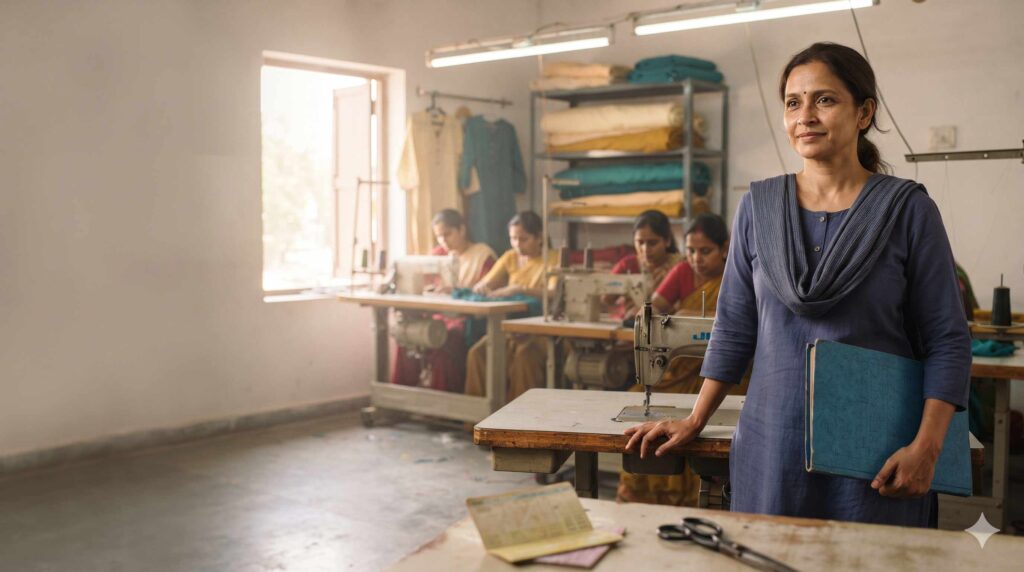
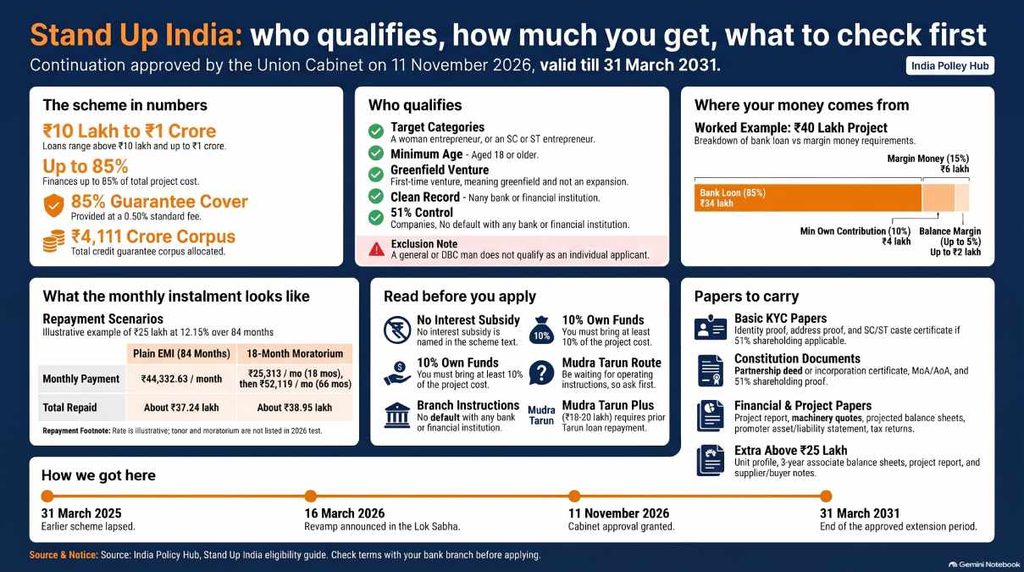
Stand Up India scheme eligibility comes down to one short gate. The applicant is a woman or belongs to an SC or ST community, is 18 or older, starts a first-time venture, has no existing default and, for a company or partnership, holds at least 51% of the shares and the controlling stake. The scheme lapsed on 31 March 2025, and the Union Cabinet revived it on 11 November 2026, with a five-year continuation that runs to 31 March 2031.
A branch visit after the lapse may have ended with “the scheme has closed”. The Cabinet approval changes that on paper, and the scheme is approved through 31 March 2031. Banks still need operating instructions under it, so a branch may say it cannot take applications yet. Ask whether it has received them before you take no for an answer.
Everything below works from that gate. The post ends with a document checklist and the application steps, so the next branch visit starts with paperwork in hand and current terms in mind.
Stand Up India Scheme Eligibility at a Glance
- Status: Stand Up India now runs to 31 March 2031. The Cabinet approved the five-year continuation on 11 November 2026 with a ₹4,111 crore credit guarantee corpus. Loans flow through Scheduled Commercial Banks, and the Stand-Up Mitra portal is the online route. Check the portal and your branch for a notice that applications are open under the approval.
- Who qualifies: Women and SC or ST entrepreneurs aged 18 or older who start a first-time (greenfield) venture in manufacturing, services, trading or agri-allied activity. A company or partnership needs 51% ownership and the controlling stake with a qualifying partner, and the borrower must not be in default.
- Loan terms: Loans run above ₹10 lakh and up to ₹1 crore, as a term loan or a composite loan with working capital, and can finance up to 85% of project cost. Under the earlier guidelines, repayment takes 7 years, with a moratorium of up to 18 months. The approval text does not list either figure, so confirm both with the branch.
- Guarantee: The credit guarantee covers 85% of the loan at a fee of 0.5%. The scheme itself carries no interest subsidy.
Also Read: Viksit Bharat 2047: India’s $30 Trillion Roadmap Explained
What Is the Stand Up India Scheme?
Stand Up India is a bank-loan scheme for first-time greenfield ventures started by women and by SC/ST entrepreneurs. It routes credit through Scheduled Commercial Banks and pairs it with a government credit guarantee and pre-loan guidance.
Launch date, nodal ministry and purpose
The scheme was established in 2016, when the Prime Minister launched it on 5 April, after the Union Cabinet approved it in January that year. It is a Government of India scheme under the Department of Financial Services in the Ministry of Finance, which is its nodal ministry. The scheme envisages placing one SC or ST borrower and one woman borrower with every Scheduled Commercial Bank branch, an average of two loans per branch, as the Press Information Bureau records.
The name is not an acronym. Portals such as myScheme abbreviate it as SUI, which settles the full form query: SUI is shorthand, not an expansion. Hindi-language pages call it the Stand Up India Yojana, and the terms are the same in every language.
Stand Up India scheme benefits: what it gives you and what it does not
A Stand Up India loan is a bank loan with a credit guarantee behind the lender and handholding help for the borrower. It is not a grant, and it is not an education loan or a personal loan. Every rupee is repaid, with interest.
The scheme itself carries no interest subsidy, and SBI lists interest subvention as nil. A subsidy enters only when a borrower pairs the loan with another central or state scheme, which section 6 covers. So the plain answer to whether Stand Up India has a subsidy is no, with that one route as the exception. Some bank pages, HDFC Bank’s among them, say a subsidy is available under the scheme. The scheme text names none, and what the scheme allows is margin money drawn from other central or state schemes (section 6.2).
What the scheme does give:
- Loans above ₹10 lakh and up to ₹1 crore for a first venture.
- A credit guarantee on 85% of the loan, which shields the lender against part of any loss.
- Margin money of up to 15% of project cost, cut from 25%.
- Pre-loan handholding through the Stand-Up Mitra portal, from project reports to training.
- A repayment window of up to 7 years under the earlier guidelines.
Is Stand Up India Still Active in 2026? Extension Till March 2031
Timeline: extension to 2025, lapse, revival
The scheme has run in three phases, and the dates below mark each one.
| Date | What happened |
| January 2016 | The Union Cabinet approves the scheme |
| 5 April 2016 | The Prime Minister launches it |
| February 2021 | Budget 2021-22 cuts margin money to 15% and brings in agri-allied activity |
| July 2021 | Parliament is told the scheme is extended up to 2025 |
| July 2024 | PIB data puts lending at over 2.35 lakh loans |
| 31 March 2025 | The original window ends |
| 16 March 2026 | The Finance Minister announces a revamp in the Lok Sabha |
| 11 November 2026 | The Cabinet approves continuation, with a ₹4,111 crore guarantee corpus |
| 31 March 2031 | New end date |
Information and Broadcasting Minister Ashwini Vaishnaw announced the November approval at the Cabinet briefing, as ET Government reported. The scheme stayed closed from 31 March 2025 until the 11 November 2026 approval, which is why a branch could say it was closed.
The answer to the status question is yes, with one caution. The approval is in place and the scheme is valid till 31 March 2031, the close of the five-year continuation, so that is the end date to quote. Branches may still be waiting for operating instructions, so ask yours whether it is taking applications.
What the 2026 approval changes, keeps and leaves unstated
The Cabinet approval, as relayed by the Prime Minister’s Office, Doordarshan and ET Government, sets out the terms in the middle column below. The right column shows the earlier position where one is on record.
| Term | 2026 approval | Earlier position |
| Loan size | Above ₹10 lakh, up to ₹1 crore | Same band since the 2016 launch |
| Loan form | Composite loan or term loan alone | The 2016 guidelines describe a composite loan covering fixed assets and working capital |
| Share of project cost | Up to 85% | A 75% loan with 25% margin in 2016; margin cut to 15% in Budget 2021-22 |
| Guarantee cover | 85% of the loan amount | Not stated in the 2016 guidelines; SBI’s page lists a maximum of 80% |
| Guarantee fee | 0.5%, described as the standard fee | Earlier fee not restated in the approval text |
| Tenor and moratorium | Not listed in the approval text; ET Government’s report gives both figures in the past tense | Up to 7 years, with a moratorium of up to 18 months (2016 guidelines) |
The approval also sets a target of at least 2.5 lakh additional entrepreneurs over the five years and records more than 2.75 lakh women, SC and ST entrepreneurs financed since April 2016. The 2024 figure in the timeline is stated as loans and this one as entrepreneurs financed. The sources do not say whether the two count the same thing, so do not read them as a growth rate.
The borrower base stays the same: women and SC or ST entrepreneurs setting up new or greenfield enterprises in manufacturing, services, trading and agri-allied activity. The cap stays at ₹1 crore. The ₹2 crore figure that some sites quote comes from the Budget 2025 announcement of a separate scheme for 5 lakh first-time women, SC and ST entrepreneurs, with term loans up to ₹2 crore over five years. The 11 November approval text keeps the ₹1 crore cap.
For Stand Up India scheme 2026 eligibility, the approval confirms the borrower groups and the greenfield focus. The finer tests on age, ownership and default come from the scheme guidelines in section 4, and revised instructions may restate them. The same holds for the tenor, moratorium, own contribution and interest ceiling in section 6, which come from the earlier guidelines and are not listed in the approval text. Ask your branch whether it has issued updated instructions under the new approval.
Stand Up India Scheme Eligibility Criteria
The eligibility criteria for the Stand Up India scheme come to six checks: category, age, credit record, ownership, first-venture status and sector. The scheme text is short on each. Where it says nothing, the bank decides. The scheme text names no educational qualification, so the requirements stay at these six checks.
Who qualifies: women, SC and ST applicants
Individual applicants get a direct answer by group. Stand Up India is a scheme for SC/ST borrowers and a scheme for women entrepreneurs, so category is the first check. For Stand Up India scheme eligibility for a female applicant, the answer is simple: a woman qualifies regardless of caste. An SC or ST man qualifies. A man in the general or OBC category does not qualify as an individual borrower.
Two one-line answers cover the searches that come up most:
- General category: a woman qualifies, a man does not.
- OBC: a woman qualifies, a man does not.
The woman route carries no caste condition, which is why a general or OBC woman qualifies. A general or OBC man can still hold a minority stake in a firm where a qualifying partner holds the 51% and the control, a case that section 4.4 covers. The scheme guidelines PDF sets out the category rule.
Age limit
The floor is 18, and the sources word it two ways. myScheme says the applicant must be at least 18 years of age, while the PIB factsheet and Vikaspedia’s page say “above 18 years”. Ask the branch how it reads the floor for an applicant who is exactly 18. The scheme guidelines list no maximum age limit, and banks apply their own credit norms. A seven-year repayment schedule has to fit the borrower’s age and income in the lender’s appraisal, so a long-tenor loan to an older applicant is a bank-level decision and not a scheme rule.
Credit history and the non-defaulter rule
One financial gate sits in the scheme’s own factsheet: the borrower must not be in default to any bank or financial institution, as the PIB factsheet records. Clear any overdue instalment before applying, because the bank sees it in the credit report.
The scheme text fixes no minimum credit score. Each bank runs its own appraisal and sets its own comfort level, and HDFC Bank says approvals rest at the bank’s discretion and depend on its own documentation and verification. Two branches can read the same report differently. A figure quoted at one counter is that bank’s policy and not the scheme’s.
Companies, partnerships and LLPs: the 51% rule
For a company, partnership or LLP, a qualifying entrepreneur must hold at least 51% of the shareholding and the controlling stake. The scheme guidelines, PNB’s guidelines page and HDFC Bank all state the test. It has two limbs, the share count and the control, and the entity needs both. The guidelines word the 51% as held by “either an SC/ST or Woman entrepreneur”, while Vikaspedia says “SC/ST and/or Women Entrepreneur” and HDFC Bank’s FAQ says “one or more” qualifying entrepreneurs. That points to qualifying partners, such as a woman and an SC partner, being able to combine their holdings, but confirm it with your branch. The guidelines do not define the controlling stake, so bring papers that show who runs the entity, such as the managing director’s appointment.
Two splits show how it plays out:
- Passes: a private limited company where a woman holds 51% and her brother, from the general category, holds 49%. She is the managing director and holds management control, so ownership and control both sit with the qualifying partner.
- Fails: an LLP with two partners, a woman and a general category man, each holding 50%. The qualifying partner is a point short of 51% and shares control, so the entity does not qualify even though half of it belongs to a woman.
The certificate of incorporation from the Registrar of Companies is the paper that shows where the majority sits, and section 7.2 lists the others. Settle the split before the file goes to the bank. Ownership papers that disagree with each other can stall the file, a point section 9 covers.
Also Read: PM Viksit Bharat Rozgar Yojana (PMVBRY) 2026: The Complete Guide
What counts as a greenfield enterprise
Greenfield is the test to settle first. The PIB factsheet PDF defines it as “the first-time venture of the beneficiary” in manufacturing, services or trading, with agri-allied activity included after the 2021 change.
Banks treat the expansion of an existing business as outside it. That is bank practice, since the scheme text does not list takeovers or brownfield deals. A branch applying that practice will ask whether the activity already runs under your name, in a family firm or in a company you control, so keep records that show the venture is new.
One gap in the wording deserves a question at the branch. The text says first-time venture and does not say whether that means the first venture ever or the first in that line of business. Opening a first cafe passes either reading. HDFC Bank’s FAQ reads greenfield as a venture where you do not already own a similar business and are not expanding an existing one, which points to the second reading. The list in section 4.7 and the checklist in section 5 use the scheme’s wording, so ask your own branch which reading it applies.
Adding a second outlet to a running cafe is an expansion, and banks treat it as outside the scheme. Ask how the branch reads the middle cases, such as an owner of an unrelated shop who now plans a manufacturing unit.
A subsidy from another scheme does not by itself rule you out. The scheme allows convergence with central and state schemes, a point that section 6.2 covers.
Eligible sectors, including a cafe business
Four sectors are open: manufacturing, services, trading and agri-allied activity. The agri-allied list covers dairy, poultry, pisciculture, fishery, beekeeping, livestock rearing, grading, sorting, aggregation, agro-industries, agri-clinics, agri-business centres, and food and agro-processing. Crop loans and land improvement such as irrigation canals and wells are excluded, and PNB’s guidelines page carries the same list. Agri-allied activity entered the scheme through the Budget 2021-22 announcement, so older bank pages may omit it.
Stand Up India scheme eligibility for a cafe business follows the same tests as any other venture. A new cafe sits under services or trading as a first venture, and it clears the sector test if the applicant clears the others. Confirm the activity code with the branch before the project report is finalised.
Who is not eligible
The eligibility of the Stand Up India scheme fails at one of six points:
- A man from the general or OBC category applying as an individual.
- An applicant under 18.
- A borrower in default to any bank or financial institution.
- A company, partnership or LLP where the qualifying entrepreneur holds under 51% or lacks control.
- A venture that is not the applicant’s first-time greenfield venture, read the way the branch reads that wording (section 4.5).
- A loan meant for crop cultivation or land improvement.
Stand Up India Eligibility Checklist, Questionnaire and Calculator
There is no official Stand Up India eligibility calculator. A yes or no checklist built from the checks above does the same job. One no ends the screen.
- Are you a woman, or a member of an SC or ST community?
- Are you 18 or older?
- Is this your first-time venture? (Section 4.5 explains the two ways a branch may read this.)
- Is it a new greenfield enterprise, and not an expansion or takeover of an existing business?
- Does the activity fall under manufacturing, services, trading or an eligible agri-allied line?
- Is the loan for something other than a crop loan or land improvement?
- Are you free of default with every bank and financial institution?
- If you apply as a company, partnership or LLP, does a qualifying owner hold at least 51% and the control? (Sole applicants answer yes.)
Eight yes answers clear the screen. They do not promise a sanction, because the bank still appraises the project.
The portal runs a second, shorter test of readiness. Its questions cover the details of your present bank account, the amount of your own investment, whether you need help raising margin money, and your prior business background. The answers sort you into one of two groups.
A ready borrower needs no handholding and goes straight to the loan application. A trainee borrower is linked to the Lead District Manager and the nearest SIDBI or NABARD office, as Vikaspedia’s Stand Up India page describes. That questionnaire is the closest thing to an official eligibility test online.
A worked margin example shows the money side. Take a ₹40 lakh project:
| Item | Amount |
| Project cost | ₹40 lakh |
| Maximum bank loan (85%) | ₹34 lakh |
| Margin money (15%) | ₹6 lakh |
| Minimum own money (10%) | ₹4 lakh |
| Balance of margin, met by subsidy or more own funds | Up to ₹2 lakh |
The ₹4 lakh floor is the number to plan around. A subsidy under another scheme can cover the last ₹2 lakh, but it cannot replace the borrower’s own 10%.
Also Read: Scholarship 2027: NSP’s New Rule on Merit and Welfare Schemes, and How to Apply
Loan Amount, Margin Money, Interest Rate and Repayment
Loan size and structure
A Stand Up India loan sits above ₹10 lakh and up to ₹1 crore, so the minimum loan amount is just over ₹10 lakh and the maximum loan amount is ₹1 crore. Needs of ₹10 lakh or less fall to schemes such as PM Mudra Yojana, covered in section 10. Mudra’s Tarun Plus band reaches ₹20 lakh, so a repeat borrower may qualify for either scheme between ₹10 lakh and ₹20 lakh. It comes as a composite loan, meaning a term loan plus working capital, or as a term loan alone, and it finances up to 85% of project cost, per the Cabinet approval.
| Term | Rule |
| Loan size | Above ₹10 lakh, up to ₹1 crore |
| Structure | Composite loan or term loan alone |
| Share of project cost | Up to 85% |
| Working capital up to ₹10 lakh | Overdraft, with a RuPay debit card |
| Working capital above ₹10 lakh | Cash credit |
| Repayment | 7 years, with moratorium up to 18 months (earlier guidelines; not listed in the 2026 approval text) |
The scheme guidelines provide for a RuPay card to operate the working capital component, and Vikaspedia’s Stand Up India page records the split: an overdraft covers limits up to ₹10 lakh, and a cash credit limit covers anything above it.
Margin money and subsidy convergence
Margin money is up to 15% of project cost. It was cut from 25% after the Budget 2021-22 announcement, as PIB reported. Central or state subsidies can fill part of it, but the borrower still pays at least 10% from own funds, a floor that SBI’s page and PNB’s guidelines page both spell out.
Who is eligible for a Stand Up India subsidy? Nobody, as such, because the scheme has none to give. The subsidy comes from the other scheme, and that scheme’s own rules decide who gets it.
The scheme guidelines add two handling rules for subsidies. A subsidy the bank did not foresee at appraisal is credited to the loan account. A subsidy counted at appraisal that arrives after commissioning can be released to the borrower to repay any loan taken for margin money. The guidelines also give a worked case: if a state scheme grants a 20% subsidy, the borrower still brings at least 10% of project cost.
The 2016 guidelines still circulating online carry the old figures of an expected 75% loan and a 25% margin, and several bank pages repeat them. Read the date on any page you rely on.
Interest rate and an EMI example
The scheme sets a ceiling and not a rate. The interest rate is the bank’s lowest applicable rate for the borrower’s rating category, capped at the bank’s benchmark rate plus 3% plus a tenor premium, according to myScheme and the scheme guidelines. The benchmark differs by bank. Some price off MCLR and others off an external benchmark lending rate (EBLR).
SBI gives one dated example. Its page shows EBLR plus 3.25%, which came to 12.15% from 15 February 2025, with no interest subvention. That rate is from early 2025, so confirm today’s rate with the branch.
For scale, take an illustrative loan of ₹25 lakh at 12.15% over 84 months. The EMI works out to about ₹44,300 a month. Across 84 months that adds up to roughly ₹37.2 lakh repaid on ₹25 lakh borrowed.
If the borrower uses the full 18-month moratorium and pays only interest during it, the monthly payment changes. The table shows both cases for the same loan and rate.
| Case | Monthly payment | Total repaid |
| No moratorium, 84 equal instalments | About ₹44,300 | About ₹37.2 lakh |
| 18 months of interest only, then 66 instalments | About ₹25,300 for 18 months, then about ₹52,100 | About ₹38.95 lakh |
That is an example and not a quote, because the sanctioned rate and tenor set the real figure. Any reducing-balance EMI calculator will test your own numbers.
Repayment period and moratorium
The repayment time period is up to 7 years, with a moratorium of up to 18 months inside that period, as SBI states. The approval text does not list either figure. ET Government’s report on the approval gives both in its description of the scheme, in the past tense, so confirm with the branch that they carry over. During the moratorium the borrower pays no principal instalments, and interest keeps accruing on the amount drawn.
With 18 of the 84 months used by the moratorium, principal instalments can run over the remaining 66 months. Ask the branch how it treats the interest that accrues in the meantime. The table in section 6.3 shows how the monthly payment changes.
Collateral and the credit guarantee
The bank takes primary security on the assets the loan creates. PNB’s guidelines page adds that the loan may be secured by collateral or by a credit guarantee scheme, so a bank can take collateral alone. The 2016 guidelines describe the guarantee as the route to collateral-free loans and name the National Credit Guarantee Trustee Company as the channel. The guarantee goes by several names. Vikaspedia calls it the Credit Guarantee Fund Scheme for Stand-Up India Loans (CGFSIL), SBI’s page and the guidelines write CGSSI, and PNB’s page lists CGTMSE or CGSSI as the schemes a loan may use.
The 2026 approval sets cover at 85% of the loan and the guarantee fee at 0.5%. SBI’s page, which does not yet reflect the approval, lists the cover as a maximum of 80%, so check the date on any bank page you rely on. SBI’s page also says the guarantee fee is calculated account by account and recovered from the borrower’s loan account.
Also Read: Dearness Allowance Hike July 2026: Cabinet Approves DA Increase to 63%
Documents Required for Stand Up India Loan
Identity, address and category proof
The KYC set is short, and it is the part of the file that a branch checks first. myScheme lists the document groups, and the branch confirms which items it accepts. The checklist calls itself indicative and not exhaustive, so a branch may add items.
- Identity proof: voter ID, passport, driving licence or PAN card, or a signature identification letter from your present banker, for the proprietor, partner or director.
- Aadhaar and passport-size photographs are not on myScheme’s list. Ask the branch whether it wants either.
- Proof of residence: a recent telephone or electricity bill, a property tax receipt, a passport or a voter ID of the proprietor, partner or director.
- Documents that establish SC or ST category where they apply, usually a caste certificate.
The caste certificate is the document that establishes category for an SC or ST applicant, so it should come from the authority that issues such certificates in your state and carry the same name as your other identity papers. Women applicants need no caste certificate, since the woman route carries no caste condition.
Business constitution and ownership papers
The entity papers depend on how the business is set up. A partnership files its partnership deed. For a sole proprietorship or an LLP, ask the branch which constitution papers it wants, since the checklist names only the deed and the company papers.
A company files its certificate of incorporation along with the MoA and AoA. Every non-individual entity also files a shareholding record that shows the 51% condition is met.
Proof of the business address belongs in this set as well, and a rent agreement is needed where the premises are rented, as myScheme lists. Where the activity falls under an MSME or SSI registration, that certificate joins the file.
Project report, financials and clearances
These are the appraisal papers. The bank reads them to judge whether the project can repay the loan, and they carry more weight than the KYC set once the identity checks clear. The project report is the centre of the file. It describes what the unit will make or sell, the machinery to be bought and from whom, the price of each item, the expected sales, the running costs and the cash left for instalments. On myScheme’s checklist the project report sits in the above-₹25-lakh group (section 7.4). For a loan between ₹10 lakh and ₹25 lakh, ask the branch whether it wants one as well.
- A detailed project report.
- Machinery quotations.
- Supplier and buyer details.
- Projected balance sheets: two years ahead for working capital limits, and for the loan period for a term loan.
- A promoter asset and liability statement.
- The latest income tax returns.
- SSI or MSME (Udyam) registration, where applicable.
- A pollution control clearance, where the activity needs one.
- Proof that you are not a defaulter with any bank or financial institution.
- Photocopies of lease deeds or title deeds of the properties offered as primary or collateral security.
The promoter asset and liability statement and the income tax returns come from myScheme’s document list. A first-time founder with no returns of her own should ask the branch what it accepts in their place. The statement covers promoters and guarantors. Ask the branch whether your activity needs a pollution control clearance.
Extra documents above ₹25 lakh
Loans with exposure above ₹25 lakh carry four more papers on the checklist: a profile of the unit, balance sheets for the last three years of any associate or group companies, a project report where term funding is needed, and a note on the manufacturing process, raw material suppliers, buyers and competitors. The profile lists the promoters, the directors, the activity, the addresses of all offices and plants, and the shareholding pattern. For a new venture with no operating history, the profile does the work that past financials do for an older firm, so it should describe who the promoters are, what the unit will do, where it will operate and how the shareholding splits. myScheme carries the same wording for the profile.
Documents Required for SBI
SBI applies its SME document set to loans sanctioned in that segment. For agri-allied activities it uses the scheme’s own documents, as its page states. The branch holds the current checklist, so ask for it before you collect papers.
Treat the checklist handed over at the counter as the final word. The guidelines also let banks set requirements such as stock statements, insurance of the assets created and reasonable processing fees, so budget for those as well.
How to Apply for the Stand Up India Scheme
Apply online: Stand Up India registration on the Stand Up Mitra portal
Registration on the portal is free. The route has four steps:
- Register on standupmitra.in with your location, category and ownership details. Have the ownership split ready if you apply as a company, partnership or LLP.
- Answer the readiness questionnaire, which covers your bank account, own investment, margin money needs and prior business background. The scheme guidelines put the number of questions at about eight to ten, and they also ask whether you need help with a project plan or skills training.
- The portal sorts you as a ready borrower or a trainee borrower. Ready borrowers move on at once, and trainee borrowers complete handholding first.
- Submit the application, upload your documents and pick a Scheduled Commercial Bank branch.
A ready borrower receives an application number, and the details go to the chosen bank, the Lead District Manager and the linked SIDBI or NABARD office. The application can be tracked on the portal afterwards. A trainee borrower is linked to the Lead District Manager and the SIDBI or NABARD office for the district, and the loan application is generated only after the handholding need is met to the satisfaction of both sides, as the scheme guidelines describe. If you have no project report, say so in the questionnaire. That answer is what routes you to handholding.
Offline routes
Applying at a bank branch directly needs no portal at all. The Lead District Manager’s office will route your application, and a Common Service Centre gives access to the portal itself. The ICICI Bank guide lists these channels.
The guidelines designate the offices of SIDBI and NABARD as Stand Up Connect Centres, 80 and 419 offices respectively when they were issued, and a borrower can use their services at any time, even after the loan is sanctioned. Where a branch has restricted internet access, its executive directs the applicant to an access point for the portal.
After you apply: appraisal, sanction and disbursal
The file moves in a fixed order. The bank checks your credit history first. It then appraises the project report, testing the market, the machinery or fit-out, the projections and your own contribution.
A site visit may follow. Sanction comes next, and disbursal follows the sanction.
The pace differs by branch. Ask the officer which stage your file has reached and which paper is still pending, and track the application on the portal if you applied there. If a stage drags, the Lead District Manager is the person to approach, because the guidelines give that office the job of following up with the bank’s regional or zonal office, and a District Level Consultative Committee under the Collector reviews cases at least once each quarter.
The portal also carries a grievance facility with contact details of the designated officer at each bank, and a bank that rejects an application must make the reason known to the borrower. Verification of your credit record and your ownership papers happens early, so errors in either surface in the first stage.
Handholding Agencies and Errors to Fix Before You Apply
Pre-loan help sits with a defined set of agencies. SIDBI, NABARD, District Industries Centres, MSME-DIs, KVIB and the Women Development Corporations help with project reports, training and margin money. The portal has been mapped to more than 8,000 handholding agencies, in figures from 2021 and 2022, as SIDBI and the PIB factsheet both record. Trainees pay training agencies directly where a fee applies.
The agencies split the work by need. Financial literacy centres give financial training, and vocational training providers give skills. MSME-DIs, District Industries Centres and RSETIs run entrepreneurship development programmes, and the District Industries Centres also help with work sheds.
State SC finance corporations, Women Development Corporations and KVIB deal with margin money. Women entrepreneur associations, trade bodies and credible NGOs mentor, utility providers arrange connections, and SIDBI and NABARD hold project profiles that feed into the detailed project report.
The scheme guidelines assign each of these roles. The portal also lists entities that help with shed or workplace identification, raw material sourcing, bill discounting, e-commerce registration and tax registration, and district events held at least once a quarter after disbursal cover the same ground for working units.
Four errors can stall a file, and each can be fixed before the application goes in:
- The project is not greenfield. Show that the activity is new under your name, and drop any plan that is really an expansion or a takeover.
- KYC or ownership records conflict. Make name, address and shareholding agree across your identity papers, PAN and the incorporation or partnership papers before filing.
- The project report carries unrealistic projections. Prepare it with a handholding agency or the District Industries Centre, and test sales and cost figures against supplier quotations.
- A past default goes undisclosed. Clear the dues and declare the history, because the bank finds it in the credit report.
Stand Up India vs Mudra vs Startup India
Three schemes get confused, and each does a different job.
Stand Up India is a bank loan above ₹10 lakh and up to ₹1 crore for the first ventures of women entrepreneurs and SC or ST entrepreneurs. The Mudra loan limit in 2026 is ₹20 lakh under the Tarun Plus category, a figure that PIB’s October 2024 release set and that Business Today still reported in August 2026. Mudra carries no category or greenfield test, though the Tarun Plus band is open only to borrowers who have repaid an earlier Tarun loan, as that release records.
Startup India, also typed as Start Up India, is DPIIT recognition, and not a loan. Under the 4 February 2026 notification, a regular startup can hold recognition for 10 years with turnover up to ₹200 crore, and a deep tech startup for 20 years with turnover up to ₹300 crore. Startup India eligibility criteria turn on the entity’s form, its age since incorporation and its turnover. Anyone asking who is eligible for a Startup India loan should know the scheme lends nothing itself, though recognition opens separate routes such as the Credit Guarantee Scheme for Startups.
A woman founder can use both: Stand Up India for the loan, and DPIIT recognition for startup benefits if the business qualifies as a startup.
Stand Up India Scheme Eligibility FAQs
When was Stand-Up India introduced?
Prime Minister Narendra Modi launched Stand Up India on 5 April 2016, after the Union Cabinet approved it in January 2016. The scheme lapsed on 31 March 2025, and the Cabinet approved its continuation on 11 November 2026.
Who is eligible for the Stand-Up India scheme in 2026?
Women and SC or ST entrepreneurs aged 18 or older who start a first-time (greenfield) venture and have no existing default. A company or partnership needs 51% ownership and the controlling stake with a qualifying partner.
Is the Stand-Up India scheme still active?
Yes. The scheme lapsed in March 2025, and the Cabinet approved continuation on 11 November 2026 for five years, to 31 March 2031. Branches may still be waiting for operating instructions under the approval, so ask yours whether it is taking applications.
What is the last date for the Stand Up India scheme?
The scheme is valid till 31 March 2031, the close of the five-year continuation that the Cabinet approved on 11 November 2026. That is the end date to quote.
Is there a maximum age limit under the Stand-Up India scheme?
The floor is 18, though sources word it two ways (section 4.2), and the scheme guidelines list no maximum age limit. Banks apply their own credit norms, so a long loan to an older applicant is the lender’s decision.
Can a man from the general category apply?
Not as an individual borrower, because the scheme covers women and SC or ST entrepreneurs only. He can hold a minority share in a firm where a woman or an SC or ST partner holds 51% and the control.
Is a woman from the general or OBC category eligible?
Yes. The woman route carries no caste condition, so a general or OBC woman qualifies if she clears the other checks on age, credit record, ownership and first-venture status.
Does the scheme give a subsidy?
No. It is a bank loan with a credit guarantee, and SBI lists interest subvention as nil. A subsidy comes only from another central or state scheme that the borrower pairs with it, and that scheme’s rules decide who gets it. HDFC Bank’s page says a subsidy is available under the scheme, but the scheme text names none.
What is the interest rate under the Stand Up India scheme?
The scheme sets a ceiling and not a rate. The interest rate is the bank’s lowest applicable rate for the borrower’s rating category, capped at the bank’s benchmark rate plus 3% plus a tenor premium. SBI’s page shows EBLR plus 3.25%, which came to 12.15% from 15 February 2025, so confirm today’s rate with the branch.
What is the margin money requirement under the Stand Up India scheme?
Margin money is up to 15% of project cost, cut from 25% after the Budget 2021-22 announcement. Central or state subsidies can fill part of it, but the borrower still brings at least 10% of project cost from own funds.
Is the Stand Up India scheme collateral-free?
Not in every case. The 2016 guidelines describe the guarantee as the route to collateral-free loans, yet the bank takes primary security on the assets the loan creates, and a loan may be secured by collateral or by a credit guarantee scheme.
What is the minimum and maximum loan amount under Stand Up India?
Loans run above ₹10 lakh and up to ₹1 crore, so the minimum loan amount is just over ₹10 lakh and the maximum loan amount is ₹1 crore. Needs of ₹10 lakh or less fall to schemes such as Mudra.
What documents are required for Stand Up India?
An identity proof such as a voter ID, passport, driving licence or PAN card, proof of residence, documents that establish SC or ST category where they apply, the entity papers and proof that you are not a defaulter. Loans with exposure above ₹25 lakh add a profile of the unit, a project report and other papers. Section 7 carries the full list.
Is a cafe business eligible for the Stand Up India scheme?
Yes, if it is the applicant’s first-time venture. A new cafe sits under services or trading, and it clears the sector test when the applicant meets the other eligibility criteria. A second outlet added to a running cafe is an expansion, which banks treat as outside the scheme.
Who is eligible for a Startup India loan?
Nobody, as such, because Startup India is DPIIT recognition and lends nothing itself. Recognition depends on the entity’s form, age and turnover, and it opens separate routes such as the Credit Guarantee Scheme for Startups. Stand Up India is the loan scheme for women and SC or ST founders.
Who is eligible for a ₹20 lakh Mudra loan?
The ₹20 lakh limit under PM Mudra Yojana belongs to the Tarun Plus category, which is open only to borrowers who have repaid an earlier Tarun loan. Mudra carries no category or greenfield test, which sets it apart from Stand Up India.
How can a founder get money from the government for a startup?
For women and SC or ST founders, Stand Up India is the bank-loan route, with loans above ₹10 lakh and up to ₹1 crore. Needs of ₹10 lakh or less fall to PM Mudra Yojana. Startup India recognition from DPIIT lends nothing itself, though it opens separate routes such as the Credit Guarantee Scheme for Startups.
For the wider field of women’s business loans and government MSME schemes, read the India Policy Hub guide on women’s business loans. Put the identity, address and ownership papers in one folder before any visit, and check that the name reads the same on every page. Then look on standupmitra.in for registration under the approval. Carry the document checklist to a branch and ask which terms it applies under the 2026 extension.
Disclaimer
This article is published by India Policy Hub for general information only. India Policy Hub is not affiliated with the Government of India, the Ministry of Finance, the Department of Financial Services, SIDBI or any bank, and does not accept or process loan applications. Details reflect public sources as of 23 November 2026, and the 2026 Cabinet approval may be followed by revised guidelines, so scheme terms can change without notice. Sanction remains at each lender’s discretion after its own credit appraisal. Loan amounts, interest rates, EMI figures and timelines shown are illustrative examples, not offers or assurances of approval. Nothing here is legal, financial, tax or investment advice. Verify current terms with your bank branch or the official portal before acting. To the fullest extent permitted by law, India Policy Hub and its authors disclaim liability for any loss arising from reliance on this content or on linked external websites.




Leave a Reply